 conusweb
 conusweb
What RAG is and how it works in enterprise chatbots
RAG explained for companies: how the model answers from your own documents, when it beats fine-tuning, and what decides the quality of a deployment.
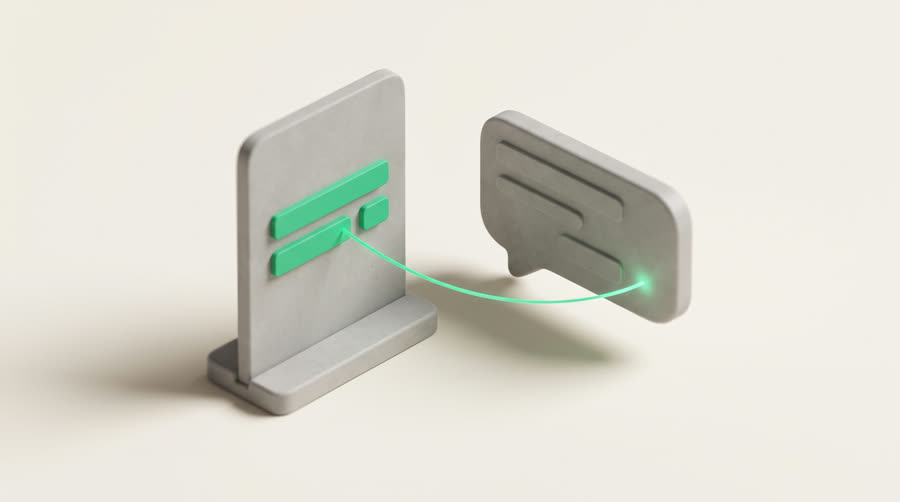
RAG (Retrieval-Augmented Generation) is an architecture that lets an AI model answer from your specific company data rather than only from the general knowledge it was trained on. Instead of the chatbot guessing or answering with stale information, the system first retrieves the relevant passages from your own database for every question, and only then does the model generate an answer. The result is a chatbot that answers accurately, currently, and with a pointer to a real source.
How RAG works, step by step
- Indexing – company documents (PDFs, wiki pages, databases, internal manuals) are split into smaller chunks and converted into vector representations, or embeddings, that capture the meaning of the text.
- Storage in a vector database – those vectors go into a database that supports fast retrieval by semantic similarity rather than by keyword alone.
- Retrieval – when a user asks a question, it is converted the same way and the system finds the most relevant document chunks.
- Generation – the retrieved passages are sent to the model along with the question, and the model composes an answer from them.
Why enterprise chatbots need RAG
An ordinary chatbot without RAG has three limitations that RAG solves:
| Problem without RAG | What RAG changes |
|---|---|
| The model does not know your internal data | It answers straight from your knowledge base |
| Information is stale, fixed at training time | Data is updated without retraining the model |
| The model invents facts (hallucination) | Every answer is backed by a specific source document |
| The source of an answer cannot be checked | The system can say which document the answer came from |
That last point is why RAG is usable inside a company and a plain chatbot often is not. An answer with a source can be verified. An answer without one has to be taken on trust.
RAG vs. fine-tuning: when to use which
Companies often confuse RAG with fine-tuning, meaning further training of the model on their own data. These are different approaches:
- RAG fits when company data changes often (prices, products, processes, documentation) and you need the model to answer from the current state without retraining.
- Fine-tuning fits when you want to change the model's behaviour or style, such as tone of voice or answer format, not to add factual knowledge.
Most enterprise deployments in practice combine both, but RAG is the base layer for working with company knowledge.
B2B use cases
- Internal company assistant – employees ask about policies, processes or documentation and get answers with a source attached.
- Customer support – the bot answers from current product data and price lists instead of a static FAQ page.
- Legal and compliance teams – retrieving and interpreting contracts, regulations or internal policies. The article on AI automation for law firms covers this in more depth.
- Onboarding and training – a new hire asks the company's own material directly instead of searching through dozens of documents.
What decides the quality of a RAG system
Not every implementation works equally well. In most failed deployments it is not the model that fails, it is the retrieval:
- Chunking – text pieces that are too large or too small reduce precision. When a table is cut down the middle, the model receives half a row and produces nonsense that reads as correct.
- Embedding model quality – this governs how accurately the system understands semantic similarity between a question and the documents.
- Refresh mechanism – how often and by what means the data is updated, and how superseded content is removed from the index.
- Metadata filtering – the ability to constrain retrieval by department, document type or access level. With several clients in one system it is a necessity, which the article on the multi-tenant vector database covers.
The quality of a RAG system is not governed by the quality of the model. It is governed by the order in your documents.
When RAG is not the right answer
When there are few questions and the answers rarely change, a well-written FAQ page is enough. When you need to calculate rather than search, you need a database query. And when the system is meant to do something rather than answer, you are looking for an agent rather than a chatbot. For the budget side of such a deployment, see what actually drives the cost of an AI agent.
Frequently asked questions
- Is RAG safe for sensitive company data?
- Yes, when implemented properly. The data stays in your own or EU-hosted infrastructure and the model only reaches it at the moment an answer is generated. The important part is enforcing access rights at the retrieval layer, not only in the application.
- Can RAG be deployed without sending data to external cloud services?
- Yes. A RAG architecture can be built fully on-premise or in an EU-hosted environment, including a self-hosted vector database and a locally running or EU-compliant model. That matters particularly for healthcare, legal and financial institutions.
- How long does it take to deploy a RAG system?
- A basic implementation for a single data source usually takes four to eight weeks. More complex systems with several integrations take longer, depending on the number and variety of data sources.
- What is the difference between RAG and simple keyword search?
- Classic search looks for an exact word match. RAG uses vector, or semantic, search that understands the meaning of the question even when the words used are not identical to the words in the document.
- Why does RAG answer incorrectly even when it has the right documents?
- Most often because retrieval found the wrong passages, or the document was split at an unsuitable point. The fault is usually in the retrieval layer, not in the model.
Related articles
What an AI agent is and how it differs from a chatbot
A chatbot answers the question; an agent completes the task. The architectural difference, three levels of autonomy, and when each is enough.
Read the article
How a multi-tenant vector database serves many clients at once
One AI infrastructure for dozens of clients without their data mixing: metadata filtering, the architectural decisions that matter, and the isolation tests.
Read the article
Security risks when deploying an LLM into company processes
Six risks that come not from the model but from the architecture around it: data leakage, prompt injection, access separation, agent actions, hallucination and auditing.
Read the article