 conusweb
 conusweb
What an AI agent is and how it differs from a chatbot
A chatbot answers the question; an agent completes the task. The architectural difference, three levels of autonomy, and when each is enough.
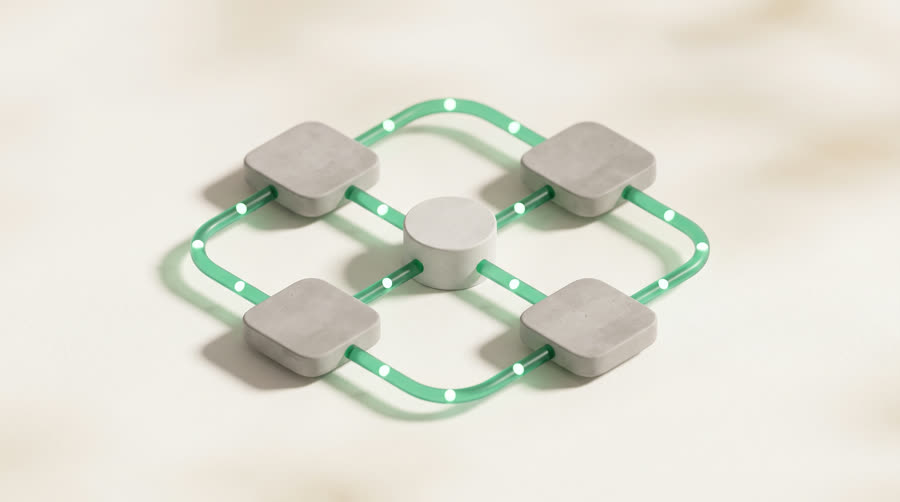
An AI agent is a software system that can plan, decide and carry out several steps on its own to reach a given goal, including working with external tools, databases and systems. A chatbot, by contrast, answers individual questions within a single conversation, takes no action outside that conversation, and does not plan a sequence of steps. Put simply: a chatbot answers the question, an AI agent also completes the task, including whatever steps that took.
The core difference: reacting versus acting
| Chatbot | AI agent | |
|---|---|---|
| Core function | Answers questions in conversation | Carries out tasks and reaches goals |
| Decision making | One step: question, answer | Several steps, plans the route |
| Tool access | Usually none or limited | Actively uses APIs, databases, external systems |
| Memory and context | Limited to the current conversation | Holds state across tasks and over time |
| Independence | Waits for the next user input | Continues the task without human input |
| Typical example | Answers a product question on a website | Processes an order, checks stock, updates the CRM, sends confirmation |
What this looks like in practice
Picture a company that receives client enquiries by email.
Chatbot. A customer asks about an order status; given the order number, the bot answers with information from the system. The conversation ends there. If something needs changing, a person has to do it.
AI agent. An email arrives, the agent reads it, determines that it is a request to change a delivery address, validates the request, updates the record in the system and sends a confirmation email. All of it without human involvement, through a chain of independent decisions.
Three levels of autonomy
- Single-task agent – performs one specific task under precisely defined rules, such as sorting email by category.
- Multi-step agent – chains several steps and chooses between branches based on context, such as processing an order with several possible scenarios.
- Autonomous multi-agent system – several specialised agents cooperate on a larger process, each responsible for a different part of it.
That division is also the main cost driver, as covered in what an AI agent costs to build.
What an agent needs to work reliably
- Access to company data – usually through a RAG architecture, so it works from current information rather than the model's general knowledge.
- Connections to tools and systems – API access to the CRM, ERP or databases, so it can actually perform actions rather than only propose them.
- Clearly defined decision boundaries – an explicit statement of what it may do alone and where it must escalate to a person.
- Monitoring and the ability to intervene – the company has to be able to see what the agent is doing and stop or correct the process.
An agent with permission to act needs boundaries as clear as those you would give a new employee on probation.
When a chatbot is enough and when you need an agent
A chatbot suffices for informational questions: FAQ-style support, searching documentation, pointing a user in the right direction. An agent is needed when the process requires real action across systems: processing orders, updating records, generating documents, coordinating several steps without a manual hand-off at each one.
Companies often start with a chatbot and move to agents once they find that recurring processes need not just answering but doing. Because an agent has access to your systems, it is worth going through the security risks of a deployment beforehand.
Frequently asked questions
- Is an AI agent just a chatbot with more features?
- No, it is a different architecture. A chatbot is reactive: it waits for input and answers. An AI agent is proactive: it can plan the sequence of steps needed to reach a goal and then carry those steps out.
- Does an AI agent always need access to company systems?
- Yes, if it is to perform real actions such as updating a record or sending a document. Without connections to your systems it is limited to generating text answers, which makes it functionally close to a chatbot.
- Is deploying an AI agent riskier than a chatbot?
- Yes, because the agent actually acts in your systems rather than only answering. That is why it is essential to define the boundaries of its decisions clearly and to have monitoring in place so the process can be checked or stopped at any time.
- Can an AI agent be rolled out gradually?
- Yes, and that is the recommended approach. Start with one specific task, verify how it behaves in real operation, and only then add further steps or connections to other systems.
Related articles
What RAG is and how it works in enterprise chatbots
RAG explained for companies: how the model answers from your own documents, when it beats fine-tuning, and what decides the quality of a deployment.
Read the article
What a custom AI agent costs to build for a B2B company
What actually drives the price of an AI agent: scope of autonomy, integrations, RAG infrastructure, compliance, and the running costs suppliers rarely mention up front.
Read the article
How AI automation works for law firms
Contract review, precedent search, compliance monitoring and due diligence — and why in a legal setting it is the architecture that decides, not the model.
Read the article